
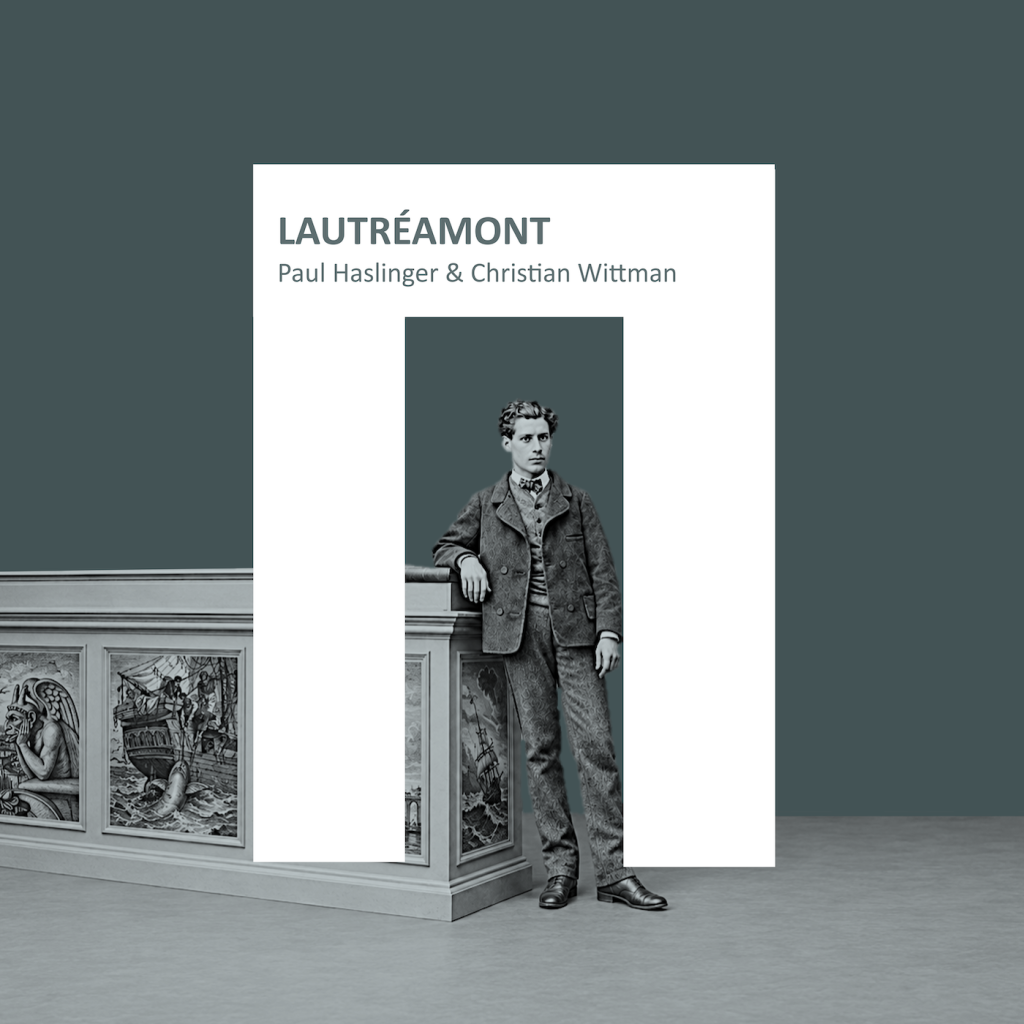
Release date: November 16, 2026
Born in 1846 in Montevideo, Isidore Ducasse died in Paris on November 24, 1870, shortly after the fall of the Second Empire. He was twenty-four years old. Very little is known about his life. Ducasse was a meteor—brilliant, fleeting.
His major work is Les Chants de Maldoror. A first book was published under the author’s name “***” in 1868. The six chants were printed in 1869 under the pseudonym Comte de Lautréamont.
“The system of scales, modes, and their harmonic sequences does not rest on unchanging natural laws, but is, on the contrary, the consequence of aesthetic principles that have varied with the progressive development of humanity, and that will vary still.” — Lautréamont, Les Chants de Maldoror (1868-1869).
Maldoror. Mal d’horreur? Evil of horror? Mal d’aurore? Evil of the dawn?
These six prose songs introduce an unprecedented voice into French literature. A voice? No, a sermon, imprecations, a confession, threats, a song of revolt and blasphemy, against everything and everyone, against humanity, against God, against morality, against conventional wisdom, against reason.
With unprecedented audacity, Les Chants de Maldoror are an epic of visceral darkness, a long nihilistic and misanthropic anathema, an uninhibited regurgitation of fantasies buried in the unconscious, a cosmological drama where heaven and hell, good and evil, hope and despair collide.
But this darkness is illuminated by flashes of great beauty—those of an incendiary language, a surrealist style ahead of its time that proceeds through collages, collisions of images, and impossible metaphors, a prose that dazzles the reader with its rhythm, its refrains, its quasi-operatic leitmotifs.
For their third collaboration, Paul Haslinger and Christian Wittman offer a musical reading of this unclassifiable and magnificent text, destined for a rich legacy of admirers and interpreters, from the Surrealists to Gaston Bachelard, from Albert Camus to Philippe Sollers.
Lautréamont invites the listener to immerse themselves in a dark and organic soundtrack, unsettling and dystopian, where sounds, like meaning, diffract into the depths of the unconscious: an oratorio of the abyss, where the enigmatic harmonics of the Chants de Maldoror weave together to perhaps, at last, reach the light of serenity.
Track List
- Mon âme est inquiète: 05:40
- Toutes les lois ne sont pas bonnes à dire: 07:48
- Primastiques irradiations: 02:52
- La solitude et l’obscurité: 04:56
- Maldoror, écoute-moi: 06:42
- Le doute est le commencement du désespoir: 05:13
- Le silence des nuits sans étoiles: 04:40
- La poésie n’est pas la tempête: 06:48
Credits
- Composition / sound design / concept: Paul Haslinger, Christian Wittman
- Mixing and mastering: Paul Haslinger
- Recorded and produced at Nina Studio (Paris) and Large Array (Los Angeles), April – September 2026
- Artwork: Axel Le Roy
- Cover photo: Photograph possibly depicting Isidore Ducasse. Portrait taken in Tarbes in 1867 by the Blanchard studio on Place Maubourguet (Public domain).