
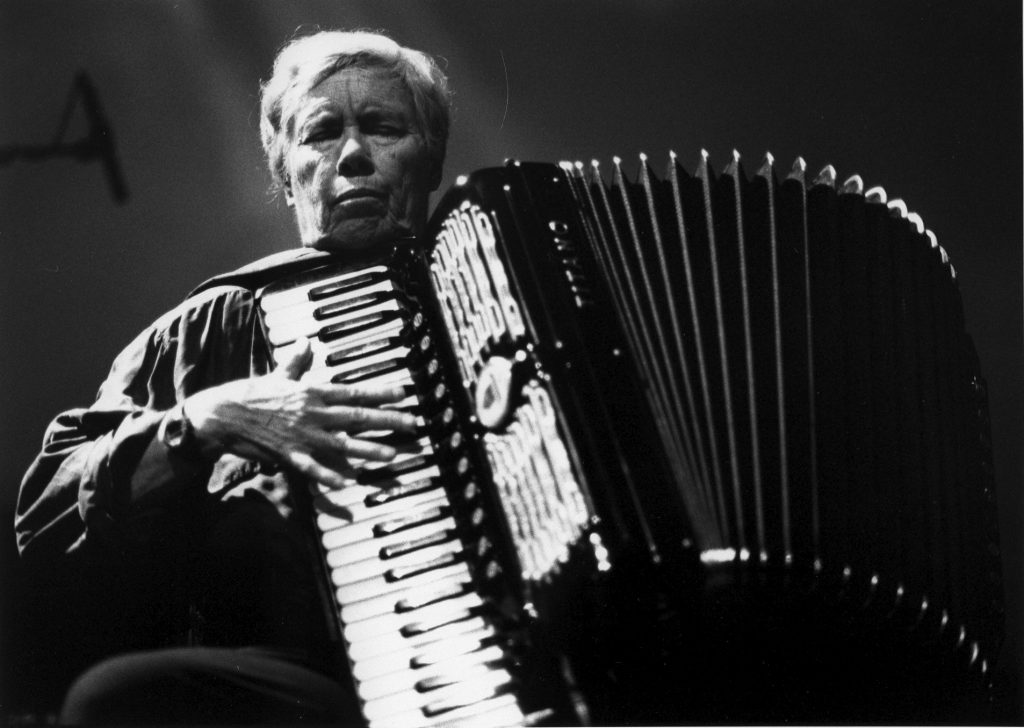
In the late ’90s, I was working as a ghostwriter and arranger for film and TV soundtracks in Los Angeles. My best client in those days was Graeme Revell, who had made a name for himself by scoring films in new and unusual ways. Graeme and his team became family, and we worked on films such as Ed Zwick’s The Siege and Wong Kar-wai’s Chinese Box. One afternoon, Graeme suggested we attend a concert that evening where Pauline Oliveros would be performing. The name sounded familiar, but I hadn’t yet grasped the full impact of Pauline’s work. Graeme had been introduced to her through a friend and wanted to say hello, so we all went.
I remember being transfixed by the performance. It was a kind of retrospective, drawing from different periods of Pauline’s career and performed with her longtime collaborators. In hindsight, it was the best introduction one could wish for. No concepts or theories stood in the way; I was simply absorbing the music, with its emphasis on space, resonance, and the qualities that exist between the notes. It allowed the intangible to shine through.
The venue was a small auditorium, perhaps eighty or a hundred people. After the performance, we all went backstage. The usual after-show mayhem unfolded: musicians meeting musicians, conversations overlapping, people drifting in and out of groups. At one point, Pauline fixed her gaze on me, walked over, and started a conversation. It was little more than introductions and a brief exchange. I imagine my time with Tangerine Dream came up, as Pauline always had a strong interest in electronic music. Yet the moment stayed with me. There was a connection.
It was only years later, after I had learned much more about her trajectory and influence—as well as the profound musical developments that took place on the West Coast during the second half of the twentieth century—that I fully understood who I had the chance to meet that day.
Pauline’s concept of Deep Listening has become one of the guiding principles in my own search for music and meaning. Memory is selective, yet my recollection of that meeting has never faded. In starting this label with Christian, I am reminded once again of how deeply Pauline influenced me, and how much inspiration I continue to draw from her example. She spoke the truth as she understood it and opened a beautiful room of possibilities for the rest of us.
In Pauline’s own words:
“Deep Listening is listening in every possible way to everything possible to hear no matter what you are doing. Such intense listening includes the sounds of daily life, of nature, or one’s own thoughts as well as musical sounds. Deep Listening represents a heightened state of awareness and connects to all that there is. As a composer I make my music through Deep Listening.”
Paul Haslinger, June 2026
- Our noion mix for Dunlab is available to listen back!
- Wandelweiser: Music Between Sound and Silence
- 2026-07-22 — Progressive Rock Journal (Jacopo Vigezzi)
- 2026-07-19 — Star’s End radio (Chuck van Zyl)
- 2026-07-16 — Beyond the Barrier
Antoine Beuger Bandcamp Brian Eno composition contemporary music creation Deep Listening Dublab experimental music guest mix instruments Jürg Frey Luciano Berio Mallarmé minimalism modernism musical creation musical label New Albion painting; multimedia art Pauline Oliveros plugins poetry recording silence stems studio work typography video installation vst Wandelweiser
Leave a Reply